Types of AI Agents (Voice, Chat, Workflow & More) and How L17 AI Uses Them | L17 AI
The Different Types of AI Agents (And How L17 AI Uses Them to Build Real, System-Level Automation)
A practical guide to the modern AI agent ecosystem — and how L17 AI designs, deploys, and orchestrates them across your business.
Introduction: AI Agents Aren’t “Bots” — They’re Digital Teammates
If you’re hearing more about AI agents, that’s because businesses are finally moving beyond:
chatbots,
scripts,
templates,
and isolated AI “widgets.”
We’ve entered the era of AI systems — groups of specialized agents working together across your communication stack, operations, data, and customer interactions.
But most business owners have no idea how many types of agents exist, which ones they need, or how they fit together. They also don’t know if they need a simple single agent for one department or a fully orchestrated multi-agent system across their entire operation.
This guide breaks everything down clearly and practically:
the main categories of AI agents
what they actually do
how “multi-agent” and “distributed” systems work
where these agents live
and how L17 AI designs, deploys, and manages these systems across real estate, development, hospitality, PE/IR, and general SMB operations
By the end, you’ll know exactly what type of agent you need for your business — and how the different pieces fit into a true AI-powered operating system.
Part 1 — The Five Core Types of AI Agents (What They Actually Do)
We start with the most practical lens: the job they perform.
These are the agents L17 AI builds and deploys daily.
1. Voice Agents (Phone-Based AI Receptionists)
These agents answer your main phone line and handle:
inbound calls
scheduling
lead qualification
FAQs
investor questions
guest/tenant support
routing to humans when needed
logging calls into your CRM
They eliminate:
missed calls
slow response time
inconsistent answers
overwhelmed front desks
reliance on a single staff member
Industries: real estate, CRE leasing, developers, hospitality, healthcare, gyms, professional services, investors, local businesses.
This is often the highest-ROI agent for most companies.
2. Chat Agents (Omnichannel Conversational Agents)
These operate across:
your website
SMS/text
WhatsApp
email
IG/FB DMs
business messaging channels
They:
answer questions
qualify leads
book appointments or tours
send documents
give pricing & availability
support investor onboarding
assist tenants/guests
This is your always-on, multi-channel communications layer.
3. Follow-Up Agents (Lead/Investor Nurture Automators)
This agent handles everything humans forget to do:
follow up every 24–48 hours
check-in on unanswered messages
ask “Do you still need help?”
nudge investors for missing documents
chase abandoned sign-ups
remind prospects to book calls
reactivate quiet leads
It handles all the “light touches” that dramatically raise:
conversions
booking rates
investor engagement
lease-up speed
online sales
These agents turn interest → action.
4. Workflow Agents (Internal Automation / Ops Agents)
These do not talk to customers.
They handle the internal work.
updating the CRM
moving leads between stages
tagging data
sending summaries
creating tasks
updating pipelines
generating internal reports
checking for overdue follow-ups
syncing platforms
These agents are the difference between a business that uses AI…
and a business that runs on AI.
5. Specialized Domain Agents (Narrow, High-Skill AI Workers)
These include:
underwriting assistants
document extraction agents
IR summary/report agents
proposal writers
research agents
tax/financial assistants
SOP/dox drafting agents
They’re designed for very specific roles inside your company.
For real estate and investment firms, these can be game-changing.
Part 2 — Single Agents vs. Multi-Agent Systems vs. Distributed AI
Next, we look at how agents are structured.
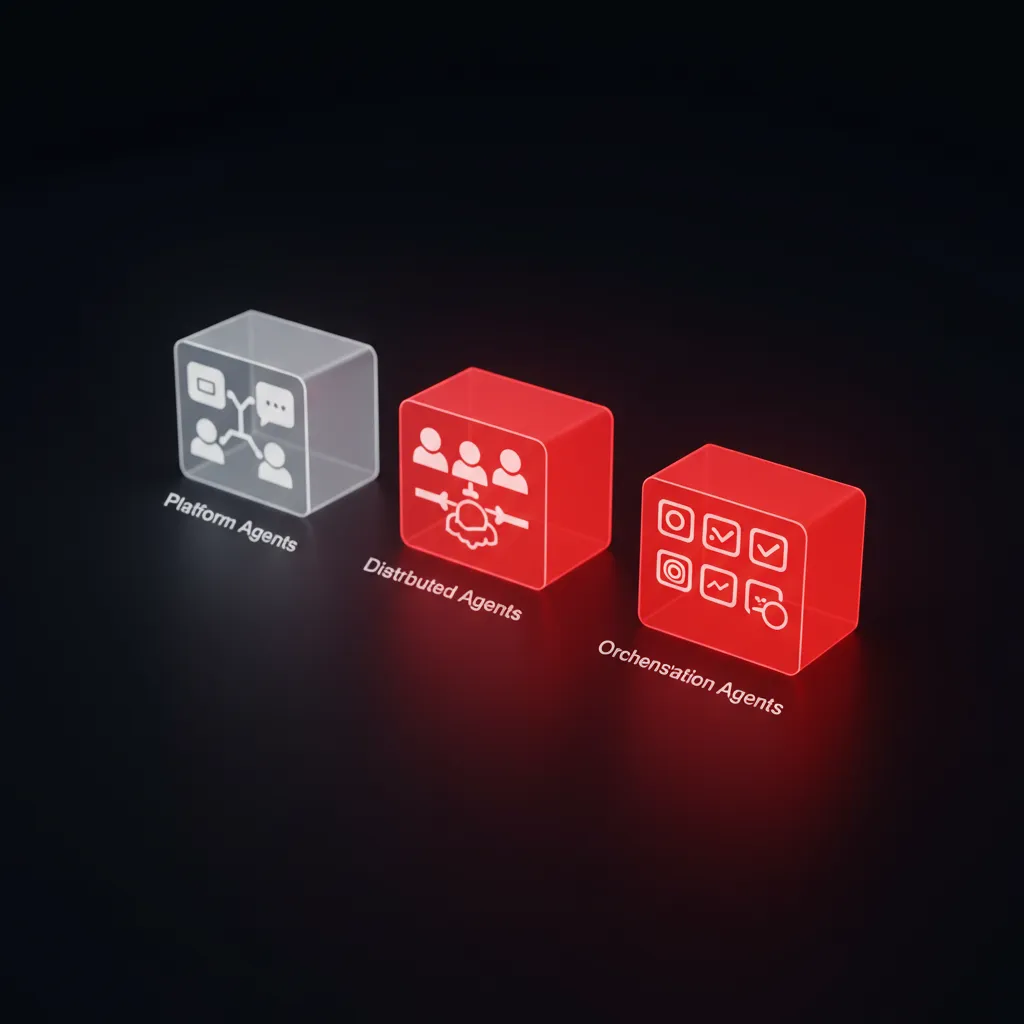
This is where the terms “platform agents,” “distributed agents,” and “multi-agent systems” come in.
1. Single Agent Systems (One Brain, One Job)
This is the simplest setup:
one agent
one system
one role
one purpose
Example:
One voice agent answering calls and booking appointments.
This is ideal for:
smaller companies
testing AI
solving one major bottleneck
replacing a receptionist
2. Multi-Agent Systems (Multiple Specialists Working Together)
This is where modern automation is heading.
L17 AI’s architectures often include:
Voice agent → handles calls
Chat agent → handles messages
Follow-up agent → nurtures
Workflow agent → updates CRM, triggers tasks
Specialized agent → reporting, IR support, underwriting
Each agent has a defined role — just like a real human team.
Benefits:
clearer logic
easier scaling
better performance
specialization of tasks
easier to maintain and refine
This is where 80% of serious businesses land.
3. Distributed Agent Systems (Cross-Platform, Cross-Channel AI)
This is what you were referencing — and it’s the highest level.
Distributed agents are:
spread across multiple platforms
communicate through APIs, CRMs, or orchestrators
each have partial autonomy
each live in their own environment
all working toward shared business goals
Picture this:
Your phone system hosts a voice agent
Your messaging system hosts a chat agent
Your CRM hosts your workflow agent
Your internal tools run specialized agents
Your website has embedded chat/DM agents
Your automation backend is orchestrating their coordination
This is extremely powerful because:
you’re not limited to one platform’s capabilities
you’re not dependent on one vendor
you can swap tools without breaking your “AI brain”
agents exist everywhere your business communicates
This is the true future of AI in business.
L17 AI builds for this model.
Part 3 — Deployment Models: Platform Agents vs. Orchestrated AI Systems
Let’s connect this with your real business infrastructure.
Model A — “Platform AI Agents”
These are agents built entirely inside one environment, such as:
your CRM
your automation tool
your messaging hub
your backend dashboard
L17 AI uses this model for:
many chat agents
SMS agents
follow-up agents
certain workflow agents
Advantages:
fast to deploy
easier for clients to manage
lower cost
stable ecosystem
great for early/mid phases
But we don’t use or mention the brand (like GoHighLevel) publicly — our solution is fully branded and delivered as L17 AI.
Model B — “Custom + Cross-Platform Orchestrated Agents”
This is where L17 AI really shines.
We build custom agents, designed to operate outside a single platform, including:
advanced voice agents
IR agents for investors
industry-specific research/summarization agents
underwriting/document agents
workflow and pipeline agents in your CRM
internal ops automators
bespoke multi-agent systems
This is “AI orchestration” — designing how agents coordinate, not just building one-off bots.
It allows us to:
build agents that talk to each other
use multiple tools together
attach AI to any part of your stack
create durable systems that scale
These systems become the AI operating layer of your business.
Part 4 — What Types of Agents L17 AI Uses in Our System (Without Naming Platforms)
Inside L17 AI’s white-labeled environment, we deploy:
✔ Voice Agents
Handle client calls, routing, lead qualification, booking, IR support.
✔ Chat + DM Agents
Handle SMS, WhatsApp, IG, Facebook, website chat, email autoresponders.
✔ Follow-Up Agents
Run sequences for leads, clients, tenants, guests, investors, applicants, etc.
✔ Workflow Agents
Run automations:
update CRMs
create tasks
move leads
trigger internal processes
summarize days/weeks
generate internal reports
✔ Custom-Built Agents
Running outside the core platform:
advanced IR reporting agents
underwriting assistants
multi-agent coordination systems
document extraction/parsing agents
research and analysis agents
cross-tool orchestrators
These allow us to support complex operations that one platform alone could never handle.
Part 5 — Why Most Companies Need a Multi-Agent or Distributed System (Not Just One Bot)
Most businesses start by thinking:
“I need an AI bot.”
What they actually need is:
a voice agent
a chat agent
a follow-up agent
a workflow agent
a specialized internal agent
and an orchestrator tying all of it together
Think about your real operations:
Clients call.
Clients text.
Clients DM.
Clients fill forms.
Clients email.
Clients expect follow-up.
Clients expect scheduling.
Your team…
can’t be everywhere at once.
A single agent won’t fix that.
A multi-agent system will.
A distributed, orchestrated AI layer is the endgame.
This is exactly what L17 AI builds.
Part 6 — The L17 AI Difference: We Build Agent Systems, Not Bots
Here’s the differentiator you can publish publicly:
**Most AI companies sell bots.
L17 AI builds systems.**
A bot is a tool.
An agent is a worker.
A system is a team.
L17 AI provides:
cross-channel AI
multi-agent coordination
workflow automation
custom agents
orchestration across your entire stack
white-labeled deployment
ongoing refinement and optimization
This creates a business that:
replies instantly
never misses a lead
follows up automatically
keeps everything organized
protects LP/investor relationships
supports clients 24/7
eliminates manual admin
scales without hiring
This is the true promise of AI for business —
not gimmicks, but operational transformation.
Final Take: You Don’t Need “A Bot.” You Need an AI System.
Understanding the different types of AI agents helps you understand a deeper truth:
AI isn’t about replacing one task —
it’s about upgrading your entire operating system.
From developers to CRE operators to investors to SMBs, a modern business needs:
front-end voice + chat agents
back-end workflow agents
follow-up and nurture agents
specialized internal agents
cross-platform orchestration
This is what L17 AI builds —
the AI layer your business will run on for the next decade.
